

SELF-EMPLOYED MORTGAGES
Being self-employed
shouldn’t make getting
a mortgage harder.
Whether you’re a sole trader, company director, contractor or
partner in a business, we’ll help you find lenders who
understand self-employed income and explain the options
available based on your individual circumstances.
✔ Whole of Market Mortgage Advice
✔ Lenders Who Understand Self-Employed Income
✔ Free Consultation
Self-Employed Essentials
Everyone’s circumstances are different. Here are some of the most common reasons homeowners choose to review their mortgage.
👨💼
Sole Traders
We’ll explain how lenders assess your income and identify those who offer the most suitable options based on your trading history.
🏢
Limited Company Directors
Many lenders assess salary and dividends, while others may also consider your share of net profit or retained profits where appropriate.
📄
Your Documents
We’ll guide you through exactly what you’ll need, whether that’s SA302s, Tax Year Overviews, company accounts or an accountant’s reference.
📈
Finding the Right Lender
Every lender assesses self-employed applicants differently. We’ll compare the market to find the lenders best suited to your circumstances.
Every self-employed business is different
Sole Traders
Lenders will usually look at your net profit, often over the latest two or three years, although some may consider a shorter trading history.
Limited Company Directors
Depending on the lender, income may be assessed using salary and dividends, or in some cases salary plus your share of company net profit.
Contractors
Some lenders may use your contract rate rather than relying solely on accounts, depending on your experience, contract history and circumstances.
Partners
For partnerships, lenders will typically consider your share of the business profits, alongside the overall strength and history of the business.
How lenders look at your income
There isn’t one single way lenders assess self-employed applicants.
Different lenders may look at:
- Latest year’s income
- Two year averages
- Salary and dividends
- Salary plus share of net profit
- Contractor day rates
- Retained profits in certain circumstances
That’s why choosing the right lender can make such a difference.
What will you usually need?
To assess your options, lenders may ask for documents such as:
- SA302s and Tax Year Overviews
- Business accounts
- Company accounts for limited company directors
- Bank statements
- Current contracts for contractors
- Proof of deposit
- Identification and proof of address
We’ll let you know exactly what’s needed based on your circumstances, so you’re not gathering unnecessary paperwork.
Only been self-employed for a short time?
Having less than two or three years’ accounts doesn’t automatically mean you can’t get a mortgage.
Some lenders will consider applicants with a shorter trading history, particularly where there is previous experience in the same industry or a strong track record of income.
We can review your circumstances and identify which lenders may be worth considering.
Why specialist advice can help
Self-employed mortgage applications can sometimes look more complicated on paper than they really are.
The key is understanding how different lenders interpret income and matching your circumstances to the right criteria.
At Liberty Money, we’ll take the time to understand how your business works and present your application in the strongest possible way.
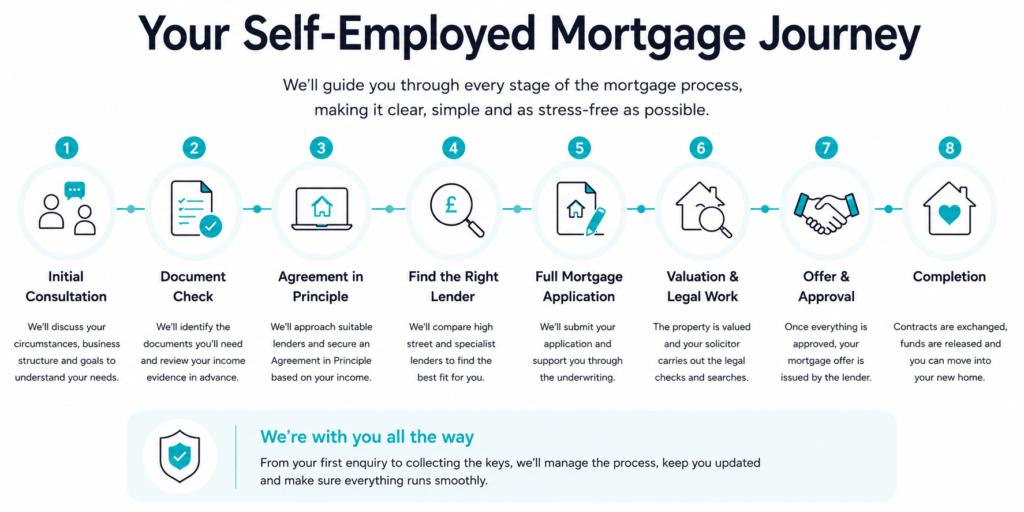
Why Choose Liberty Money?
Being self-employed doesn’t mean your mortgage options are limited—it simply means choosing the right lender is even more important.
We’ll take the time to understand how your business operates, explain how different lenders assess self-employed income and recommend the mortgage that’s best suited to your circumstances.
Independent mortgage advice
Clear comparison of your options
Support from review to completion
Advice tailored to your plans
Costs to Consider When Applying for a Self-Employed Mortgage
The costs involved are usually the same as any other mortgage application, but understanding them in advance can help you budget with confidence.
Adviser Fees
We’ll explain our fees clearly before you proceed, so you’ll always know exactly what to expect.
Valuation Fees
Many lenders include a free mortgage valuation, although some products may charge depending on the lender selected.
Legal Fees
Your solicitor or conveyancer will handle the legal work required to complete your purchase or remortgage.
Mortgage Product Fees
Some mortgage products include arrangement fees, while others are fee-free. We’ll compare the overall cost to help you find the right solution.
Accountant’s Information
Some lenders require additional information from your accountant. We’ll let you know exactly what’s needed before your application is submitted.
Business Considerations
We’ll discuss how your trading structure, recent accounts and future plans could influence the lenders available to you.
Frequently Asked Questions
Ready to Find the Right Self-Employed Mortgage?
Whether you’ve been self-employed for one year or twenty, we’ll help you compare mortgage options and guide you through every stage of the application.
Explore Related Mortgage Guides
Many of our clients explore more than one mortgage option before deciding what’s right for them. Here are some related guides that may also be useful.